
Use Case · Utility
Grid Support
Fast, dispatchable utility-scale storage for capacity, frequency response, ramping, and firming — with bankable documentation and sub-second response.
Problem
Why this matters.
As renewables grow, grid operators face rising variability and capacity constraints. They need assets that respond in sub-second timeframes, stack multiple services on the same fleet, and arrive with type-test documentation and standards compliance — not just raw megawatt-hours.
The utility planner buys against a system curve, not a site curve — evening ramps steepening as solar penetration rises, capacity shortfalls concentrated in a few hundred hours a year, and renewable output that must be firmed before it counts toward reliability. Storage is procured as infrastructure, so documentation, IEC compliance, long-term service, and augmentation planning matter as much as cell chemistry.
Navvion Approach
How we deliver results.
Architecture
How the system fits together.
Containerized battery blocks connect through step-up transformers to the substation bus. SCADA and IEC 61850 telemetry link the fleet to the operator's dispatch, response is validated at the point of interconnection during commissioning, and the plant scales by adding Navvion Gamma containers rather than redesigning the system.
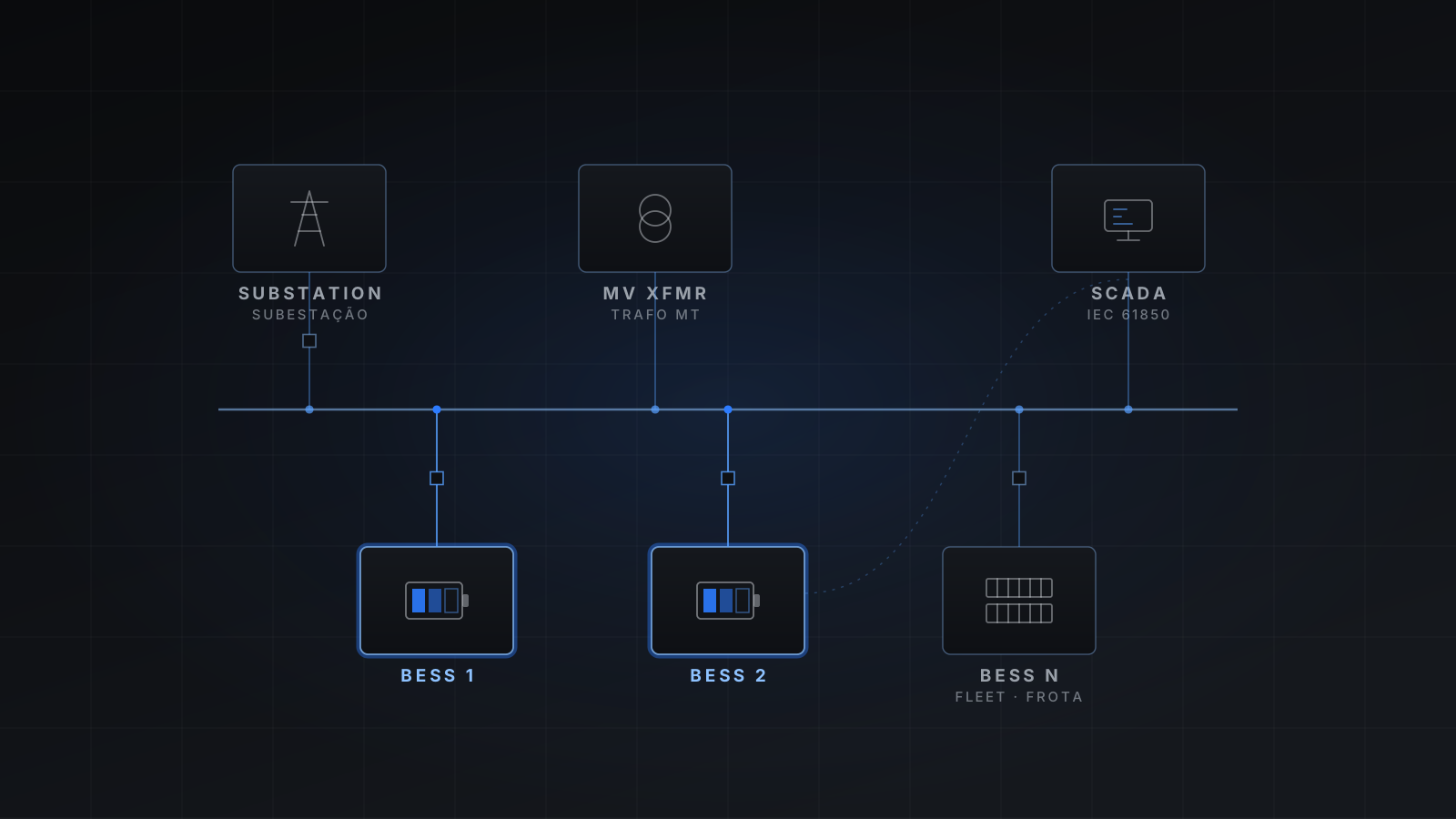
Simplified one-line diagram. Final architecture is engineered per site.
Products Used
Navvion systems for this solution.
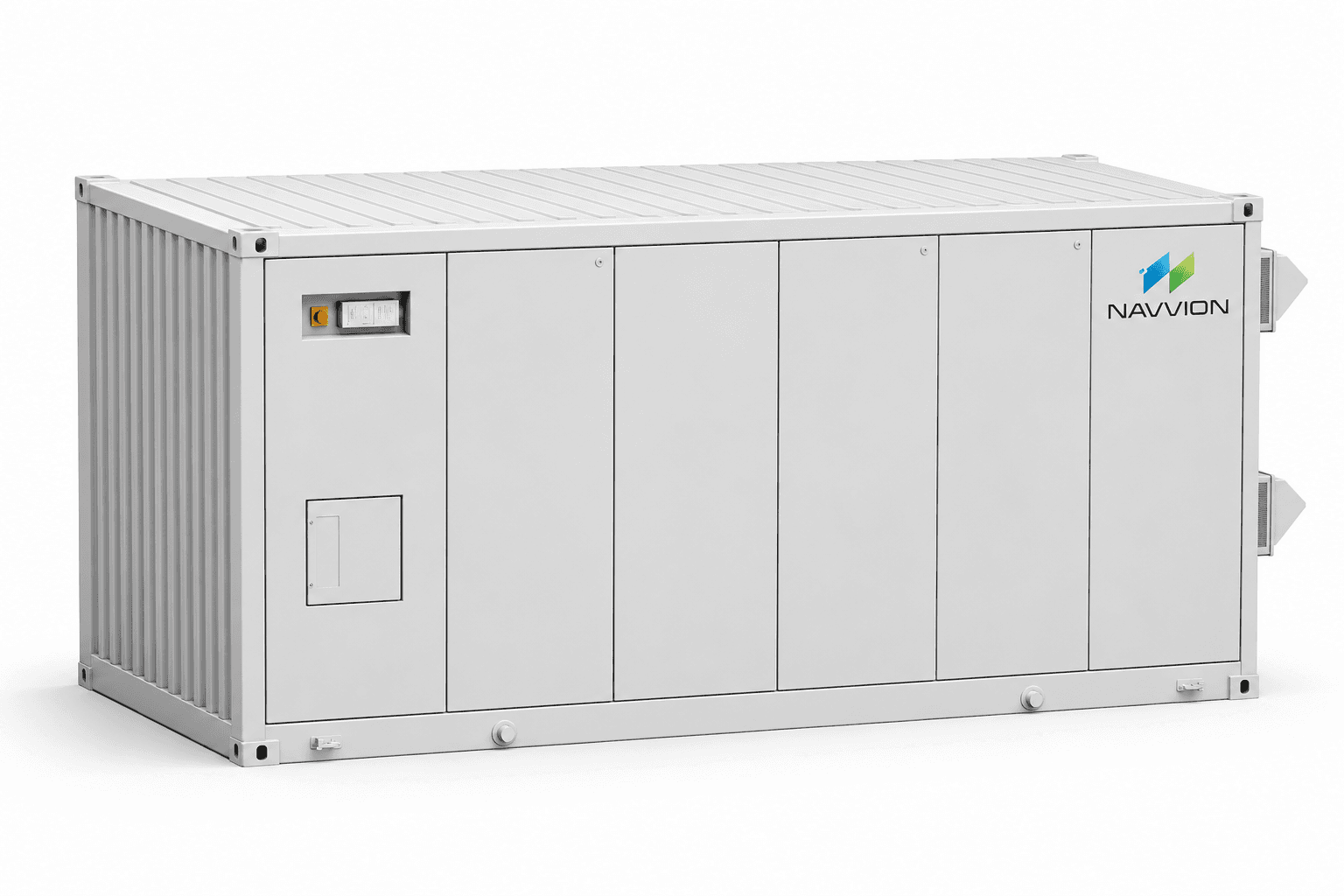
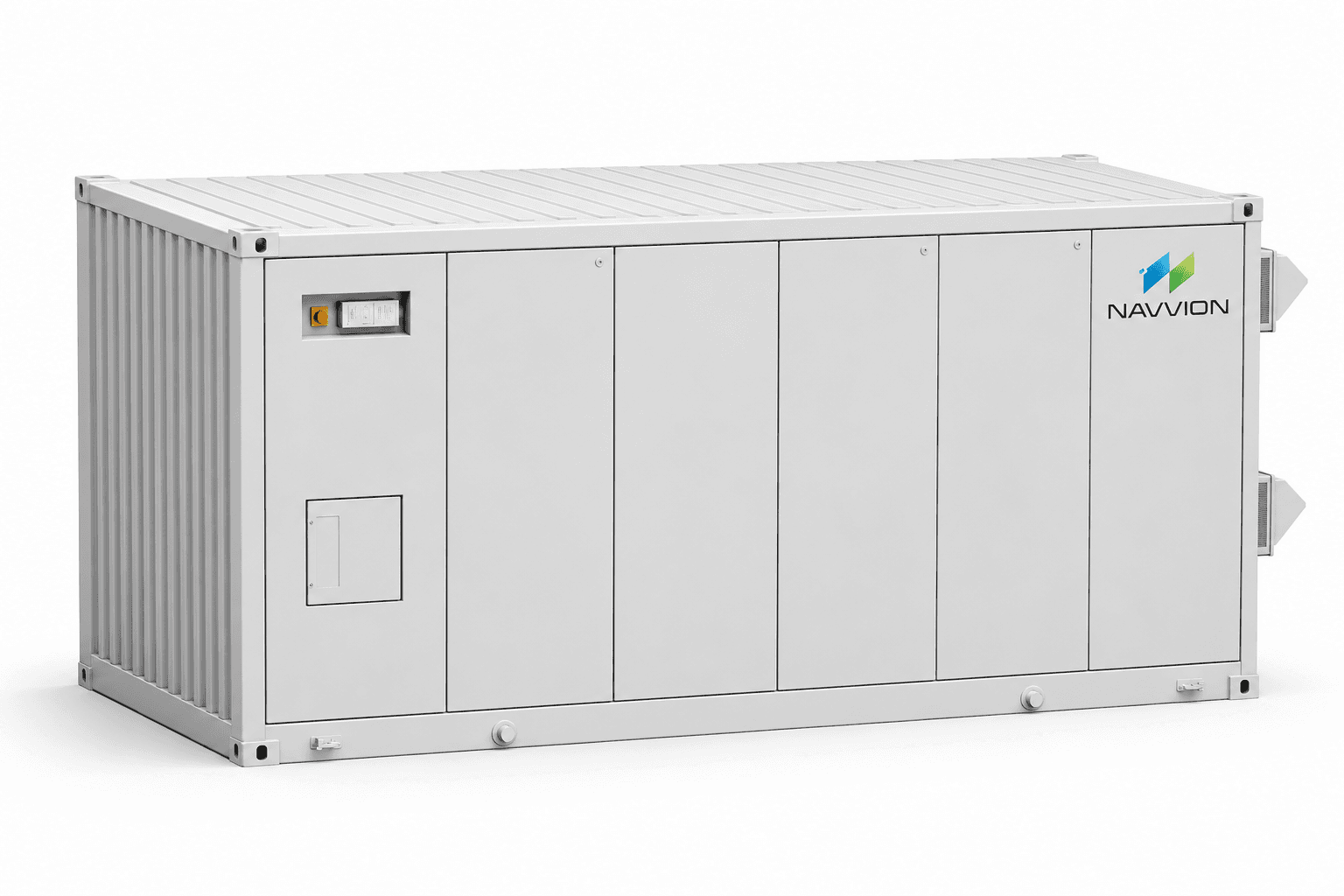
The 5 MWh liquid-cooled Navvion Gamma (ESS-C-20-5015D-L-2H) is the transmission-connected fleet building block; the 3.3 MWh all-in-one Navvion Delta (ESS-C-20-3343A-L1-2H) fits distribution-level, substation-adjacent, and space-constrained sites.
- Project development
- Engineering and system design
- Interconnection support
- Commissioning and response validation
- Fleet APM
- Long-term service and augmentation
Economics
What the payback looks like.
| Building block | 5 MWh / 0.5P liquid-cooled container |
| Installed cost | $260 / kWh |
| Energy shifting | 1.5 cycles/day @ $0.06/kWh |
| Installed cost per container | $1.30M |
| Energy-shifting revenue | $164,250 / yr |
| Capacity / ancillary revenue | Contract-specific |
| Simple payback | Modeled per service mix |
Illustrative scenario using the default assumptions from our ROI calculator. We model real savings against your actual tariff and load profile.
Run your numbersFAQ
Common questions.
Which grid services can the fleet stack?
Capacity, frequency response, ramping, and energy shifting — the mix depends on your market's rules. We model revenue stacking per contract before fixing the fleet size.
How fast does the system respond to a dispatch signal?
The PCS responds in sub-second timeframes at the point of interconnection; end-to-end latency is validated during commissioning against your telemetry requirements.
What documentation supports interconnection?
Certified type-test reports, site one-lines, protection studies, and IEC 61850 point lists — prepared as part of the project-development service.
Which markets and grid codes do you support?
Response curves are configured and validated against your grid code at commissioning, and certified type-test documentation supports interconnection in Navvion's certified markets — the US, Brazil, Chile, Portugal, Spain, Germany, and the UK, with details on request.
How do you plan augmentation over the plant's life?
The plant is laid out with augmentation bays and DC headroom from day one, so capacity is restored or grown by adding containers on the existing design rather than redesigning the system.
Can the fleet firm a specific solar or wind plant?
Yes. Firming is modeled against that asset's generation profile and combined with capacity and ancillary services into a single revenue stack.
More Solutions
Explore related applications.
Let's model your project.
Send your load profile through the intake form and we'll respond with a sizing analysis.
What we need to start.
- Service/offtake contracts or market rules
- Site one-line diagram
- Interconnection studies
- Grid-code response requirements
- Telemetry/SCADA point list
- Land and civil constraints