
Use Case · Microgrid
Microgrids
Self-sufficient power for remote, industrial, and mission-critical sites — storage, solar, and generators coordinated on one bus by NavvionOS.
Problem
Why this matters.
Remote and weak-grid sites — mines, agriculture, industrial campuses, telecom and critical facilities at the end of a long feeder — cannot rely on the grid alone. Feeders sag and drop, and the usual answer is to run diesel around the clock as spinning reserve, burning fuel and emitting even when the load is light. What these sites need is a self-sufficient architecture that integrates solar, generators, and storage, holds power quality on a weak or absent grid, and hands off cleanly and automatically between grid-tied and islanded modes.
The NavvionOS Edge Controller and EMS are the brain of the microgrid, and the dispatch story runs in two modes. Grid-tied, they optimize cost — managing demand, arbitraging energy, and holding the generator in reserve. Islanded, the hybrid PCS grid-forms the bus in under a cycle and the generator becomes a dispatchable reserve that runs at a proper load factor instead of idling, so it burns less fuel for the hours it does run. PV serves the daytime load directly, and the battery bridges the overnight autonomy gap. The result is a site that leans on stored solar first, calls the generator only when it earns its keep, and keeps critical loads up whether or not the utility is there.
Navvion Approach
How we deliver results.
Architecture
How the system fits together.
A microgrid controller supervises the point of common coupling (PCC), PV inverters, generator, and battery on one bus. Grid-tied, the system optimizes cost; islanded, the battery grid-forms and the generator becomes a dispatchable reserve. When the utility returns, resynchronization to the grid is automatic and seamless to downstream loads. The same design scales from a single Navvion Omega cabinet at a remote site to a multi-source containerized bus for a full industrial microgrid.
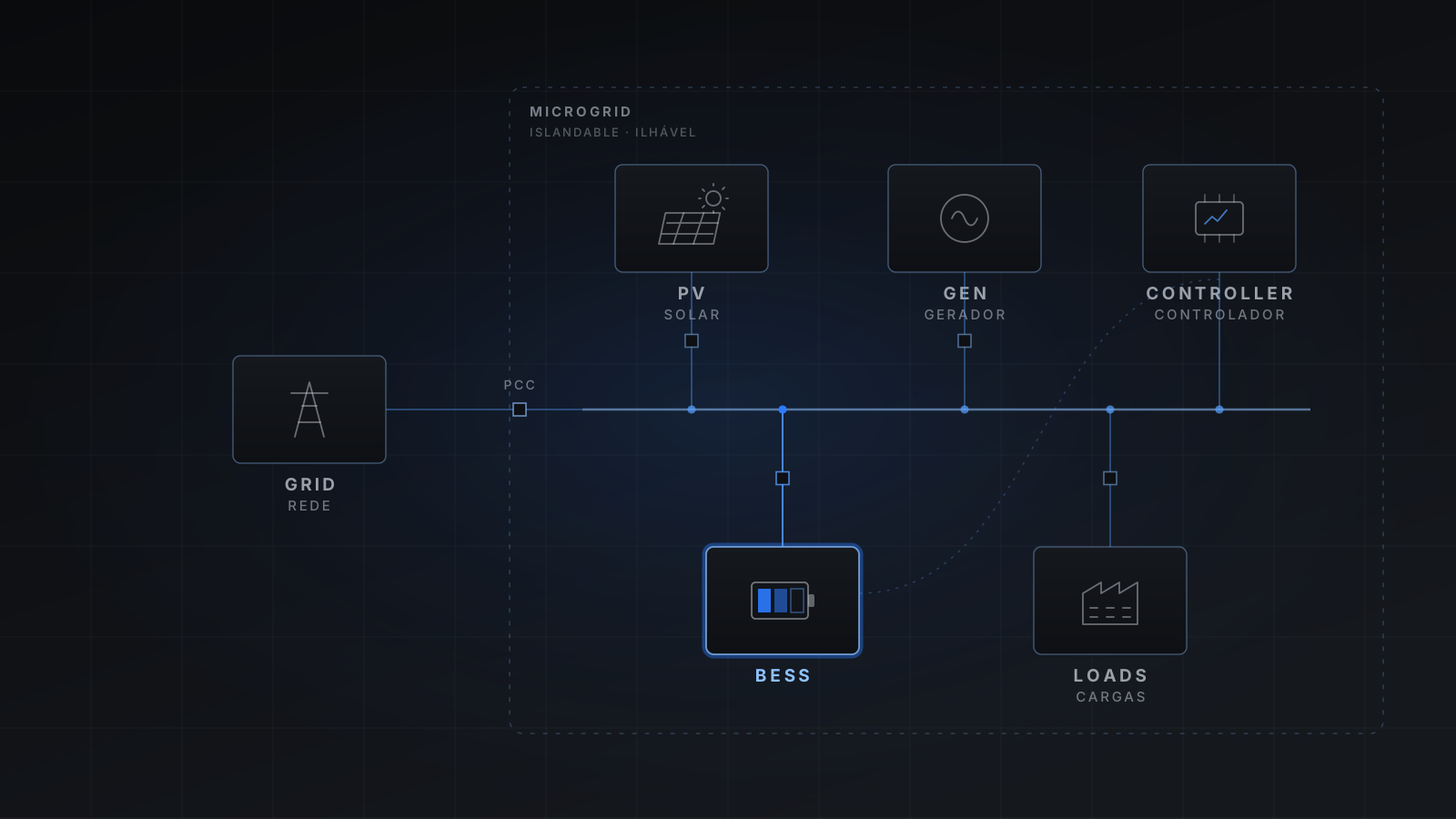
Simplified one-line diagram. Final architecture is engineered per site.
Products Used
Navvion systems for this solution.
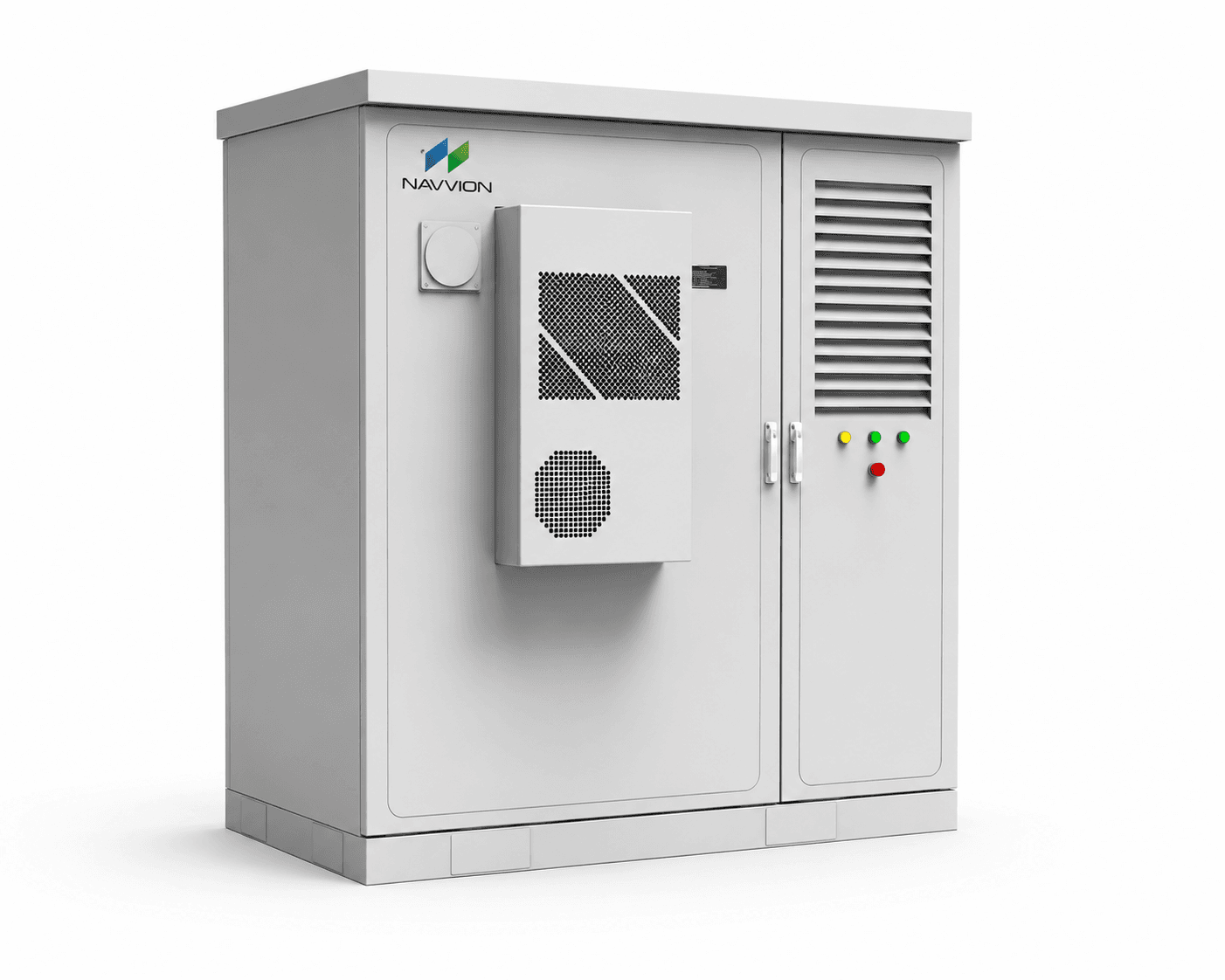
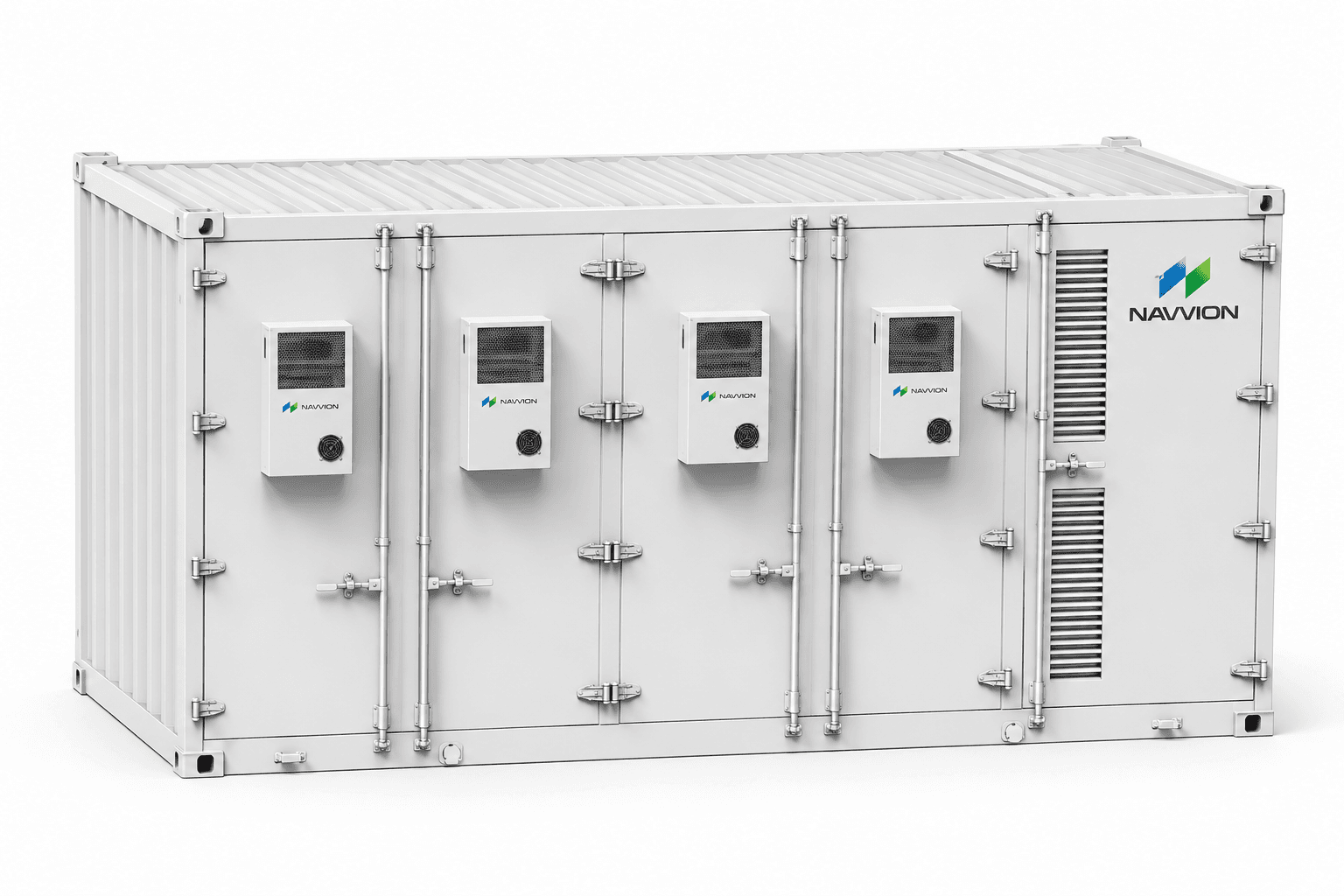
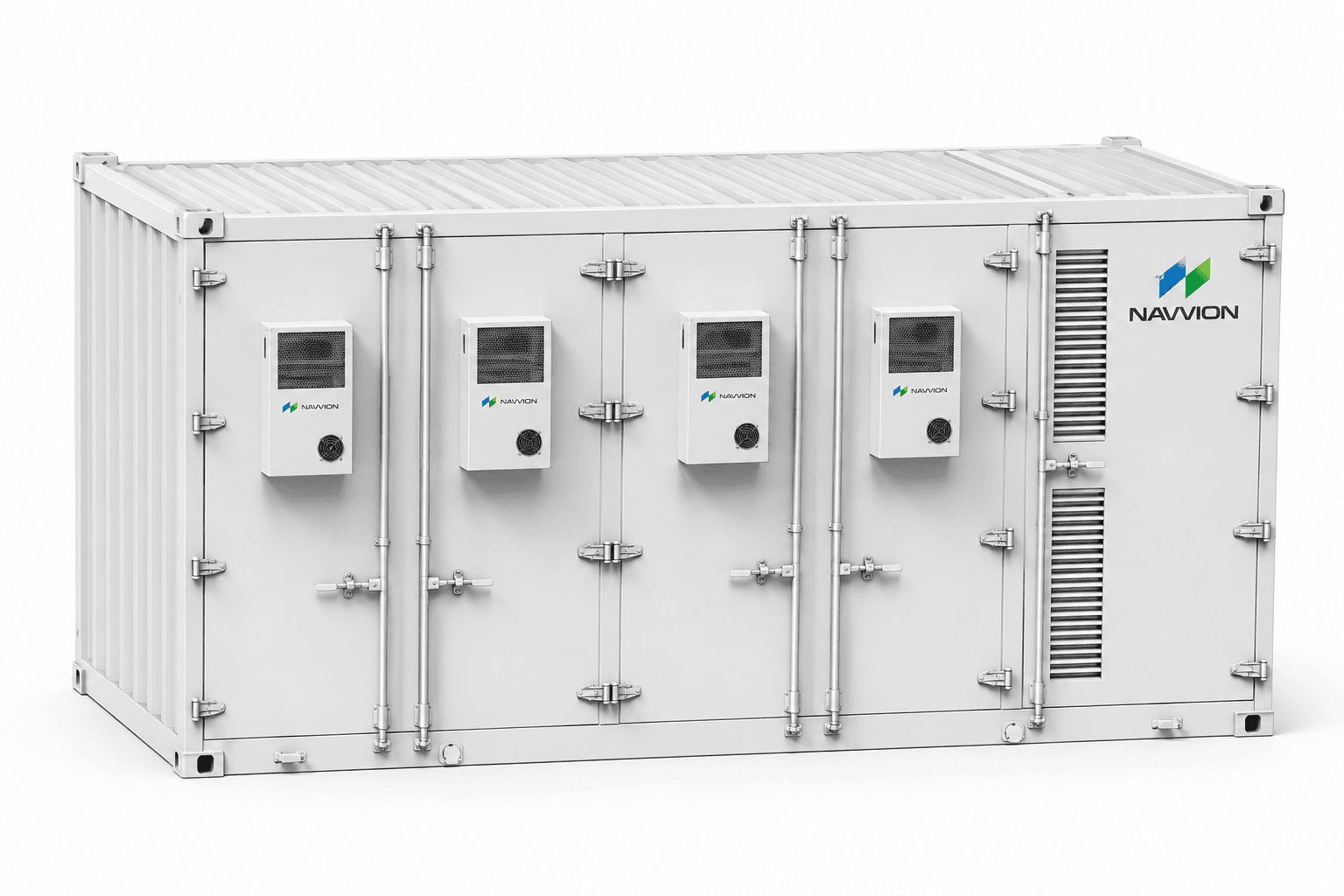
The Navvion Omega (112–145 kWh) brings native grid-forming and generator coordination at cabinet scale for remote and satellite sites. To anchor larger multi-source microgrid buses, the ~2 MWh Navvion Zeta (ESS-C-20-2057A-F1-2H) and the 2.6 MWh Navvion Epsilon (ESS-C-20-2612A-L1-2H) add air- and liquid-cooled capacity behind the same controller.
- Architecture design
- EMS / Edge Controller configuration
- PV + generator integration
- Commissioning
- Field service
- Remote APM monitoring
Economics
What the payback looks like.
| Building block | 1 MWh / 500 kW hybrid microgrid |
| Installed cost | $430 / kWh |
| Fuel-displacement spread | $0.20 / kWh (diesel vs. stored solar) |
| Utilization | 1.2 cycles/day |
| Target autonomy | 4–8 h islanded |
| Installed cost (1 MWh block) | $430,000 |
| Fuel-displacement savings | $87,600 / yr |
| Resilience value | Outage-cost avoidance, site-specific |
| Simple payback | Modeled per generation mix |
Illustrative scenario using the default assumptions from our ROI calculator. We model real savings against your actual tariff and load profile.
Run your numbersFAQ
Common questions.
Can the microgrid run indefinitely off-grid?
With enough PV and fuel, yes — the design question is the generation mix for your load curve and how many hours of autonomy the battery must bridge overnight.
How does the handoff between grid-tied and islanded work?
The controller opens the PCC breaker on a grid event and the battery is already grid-forming, so downstream loads see a seamless transition; resynchronization is automatic when the grid returns.
Does a microgrid require replacing existing generators?
No — existing generators are usually integrated as a dispatchable reserve, running fewer hours at better load factor.
How many hours of autonomy should the battery cover?
It is sized from your load curve and how long you must ride out before a generator or the grid returns; the design trade is battery hours versus generator runtime.
Can we start grid-tied and add islanding later?
Yes — the Navvion Omega PCS and Edge Controller are specified for grid-forming from day one, so islanding is a configuration and protection step, not a hardware swap.
How is the microgrid monitored and controlled remotely?
Through NavvionOS — the Edge Controller on-site, plus APM / Cloud Monitoring off-site with remote diagnostics and operator overrides.
More Solutions
Explore related applications.
Let's model your project.
Send your load profile through the intake form and we'll respond with a sizing analysis.
What we need to start.
- Site load curve (interval data)
- Existing generator specs and fuel logistics
- PV size / generation potential
- Required islanded autonomy hours
- Interconnection / PCC constraints
- Critical-load list