
Industry
Commercial & Industrial
Behind-the-meter storage for retail, manufacturing, warehouses, and corporate campuses — one asset for demand savings, backup, and solar.
Problem
Why this matters.
C&I operators face rising energy costs, demand-charge peaks driven by a few hundred hours a year, power-quality needs, and reliability requirements. Storage is the unifying layer that addresses all of them at once — behind the meter, without changing how the facility runs.
Commercial buildings peak mid-afternoon on HVAC; manufacturing peaks at shift changes and motor inrush. Both pay demand charges out of proportion to average consumption — a few hundred hours a year set the bill, and that is exactly the profile a battery compresses. The same battery and NavvionOS EMS run demand management every day while holding a state-of-charge reserve for backup, and deployment can be staged building-by-building across a campus so capital follows the load.
Navvion Approach
How we deliver results.
Architecture
How the system fits together.
A Navvion cabinet or container sits at the main switchboard behind the meter, with optional PV coupling. The EMS runs demand management daily and reserves state-of-charge for backup where required — with no change to how the facility operates.
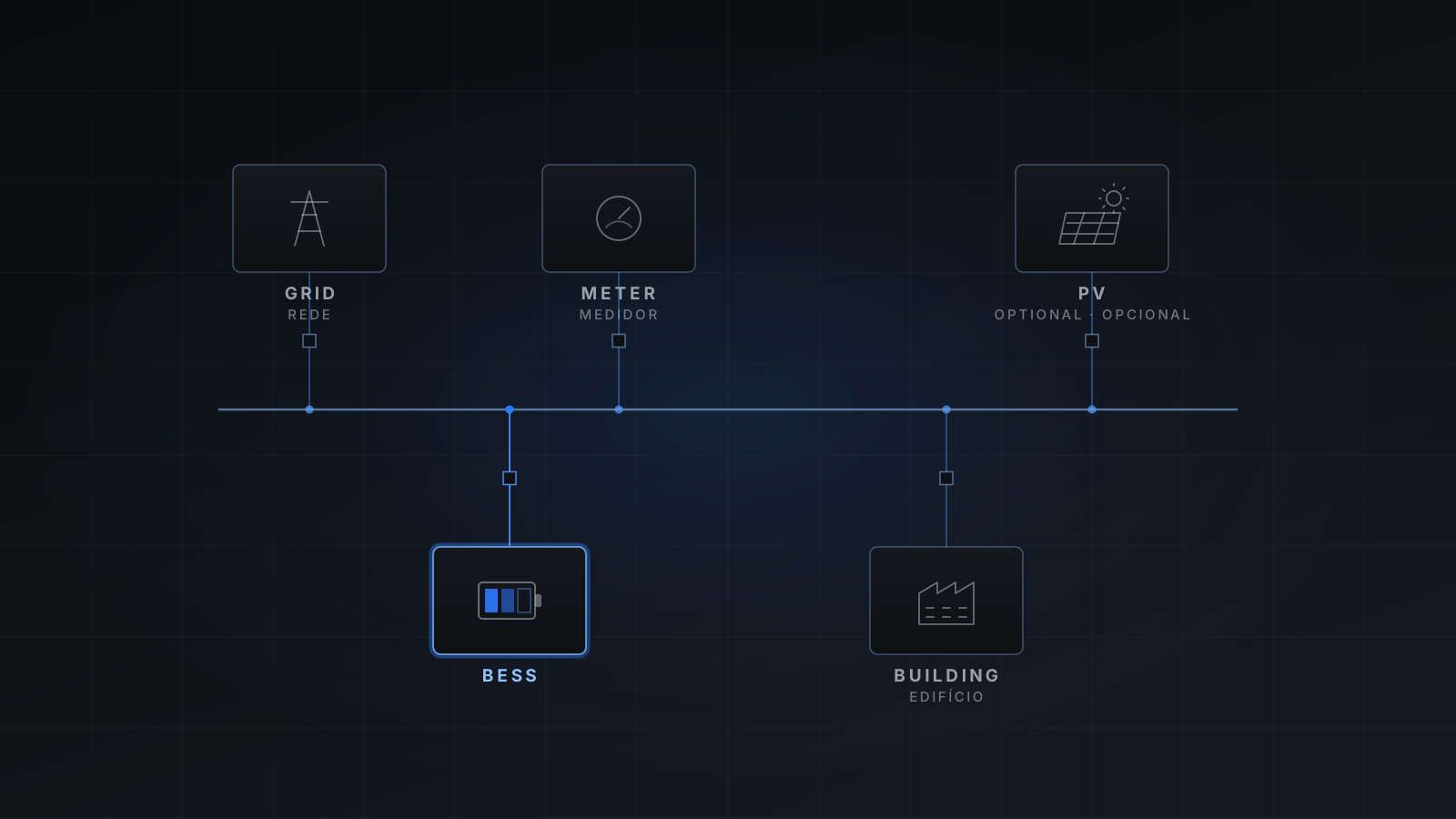
Simplified one-line diagram. Final architecture is engineered per site.
Products Used
Navvion systems for this solution.
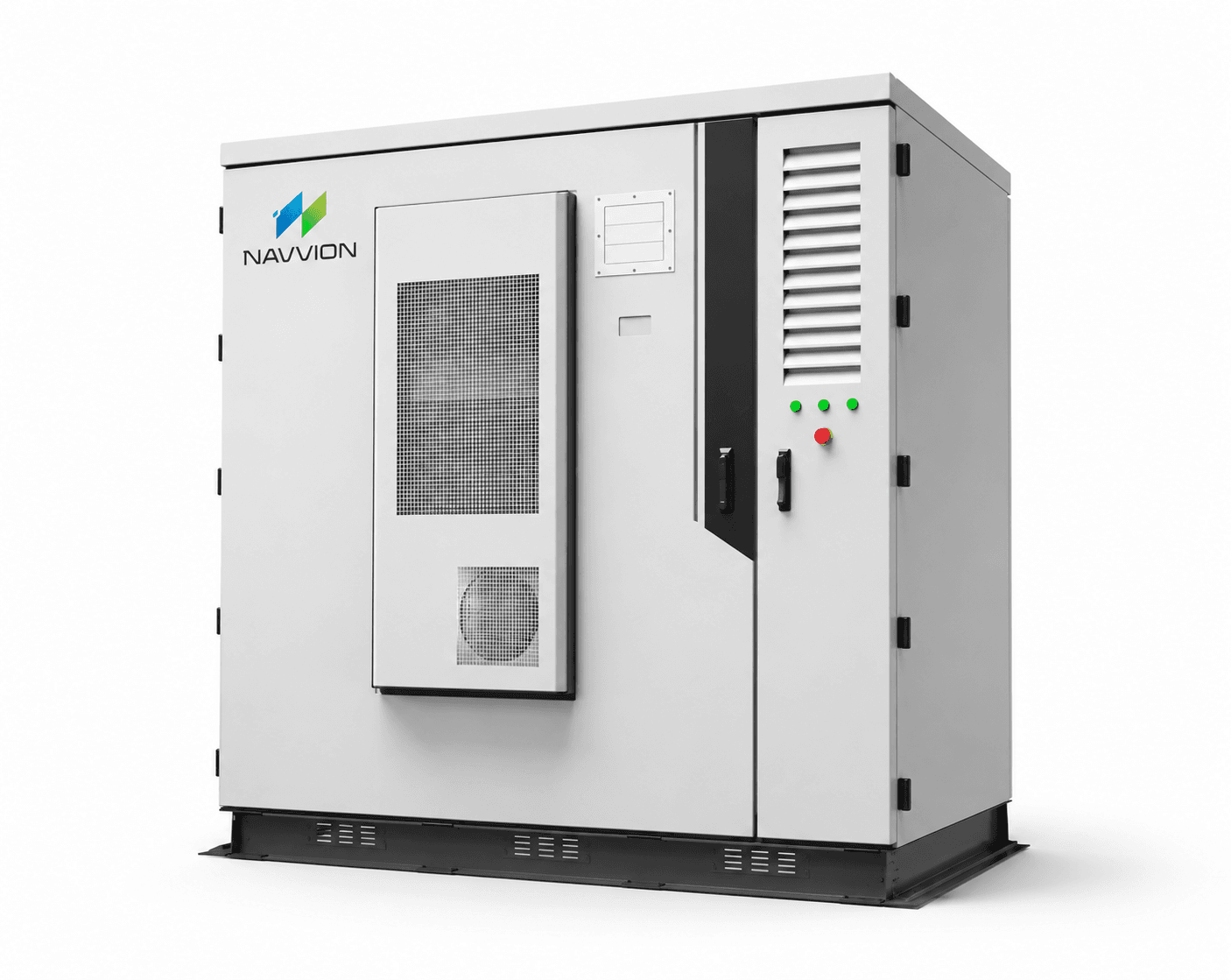
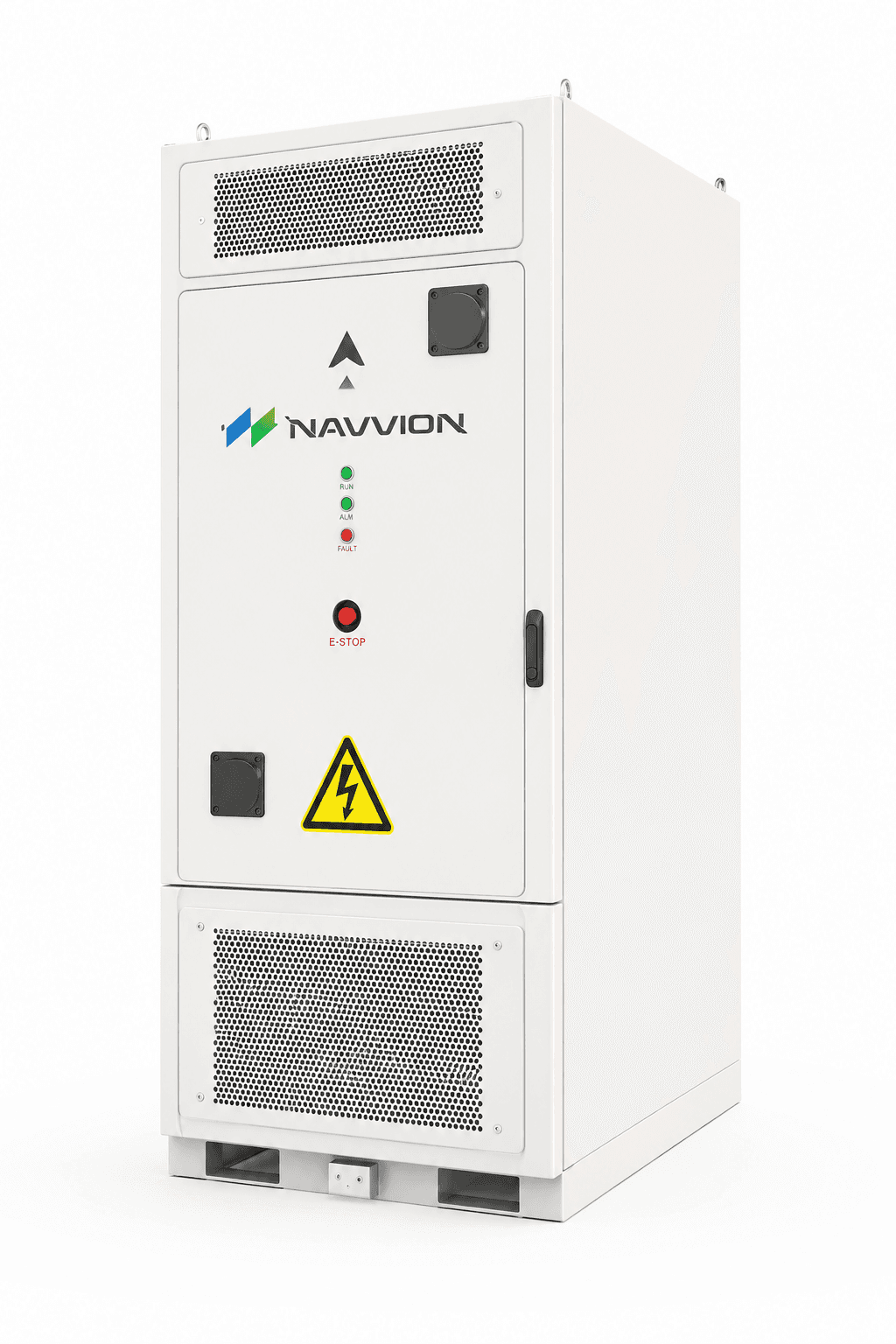
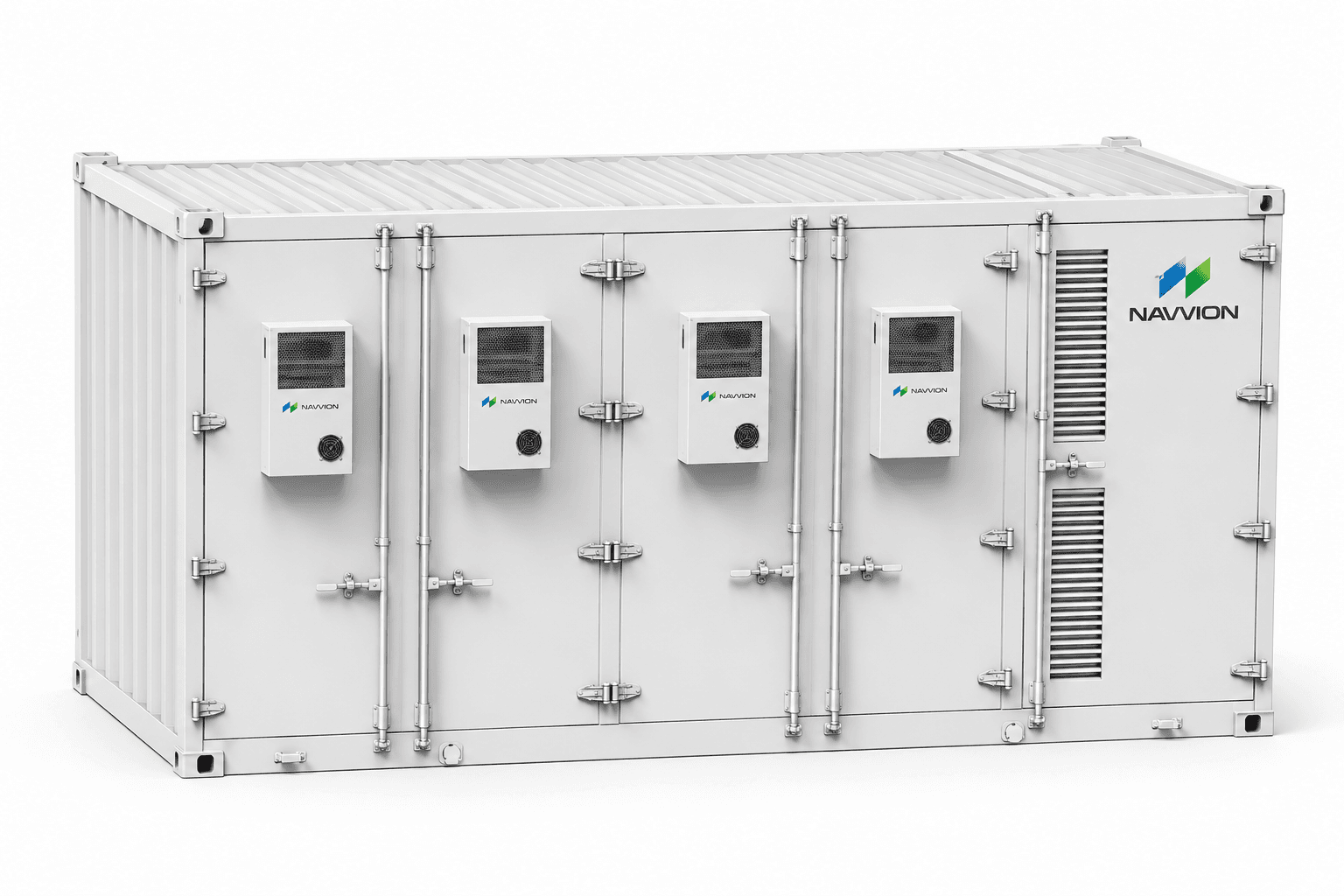
The Navvion Alpha (ESS-C-JG257A-F2-2H0, 257 kWh, air-cooled) and Navvion Beta (ESS-C-JG261A-L1-2H0, 261 kWh, liquid-cooled) cabinets match single-building loads and parking-lot footprints; the ~2 MWh Navvion Zeta (ESS-C-20-2057A-F1-2H) serves campuses and heavy single-site consumers.
- System sizing
- Financial modeling
- Design
- Installer coordination
- Commissioning
- APM onboarding
- After-sales service
Economics
What the payback looks like.
| Battery size | 500 kWh / 250 kW |
| Installed cost | $420 / kWh |
| Incentive / tax credit | 10% of CAPEX |
| Demand charge | $20 / kW-mo |
| Monthly peak reduction | 200 kW |
| Energy shifting | 1 cycle/day @ $0.05/kWh |
| Net installed cost | $189,000 |
| Demand-charge savings | $48,000 / yr |
| Energy-shifting savings | $9,125 / yr |
| Simple payback | 3.3 years |
| 20-year net return | $953,500 |
Illustrative scenario using the default assumptions from our ROI calculator. We model real savings against your actual tariff and load profile.
Run your numbersFAQ
Common questions.
What size system does a typical commercial building need?
Most single buildings land in the 100–500 kWh range, but the honest answer comes from your interval data — we size from twelve months of it.
Where does the cabinet physically go?
Outdoor-rated cabinets take roughly a parking space next to the electrical room; containers need a pad and truck access. Siting is part of the survey.
Who operates the system after commissioning?
Nobody on your staff has to — dispatch is automatic and monitored through Navvion APM, with service handled under the after-sales agreement.
Can one system do demand savings and backup at the same time?
Yes. The EMS runs demand management daily while reserving a state-of-charge floor for backup, and we size for both from your load profile and critical-load list.
What's the timeline from intake to commissioning?
It is driven by interconnection and equipment lead time. The sizing analysis follows the intake quickly, and installation is scheduled around your operations.
Do you serve multi-site portfolios?
Yes. Cabinets standardize per building and roll out in stages, all monitored as one fleet in Navvion APM.
More Solutions
Explore related applications.
Let's model your project.
Send your load profile through the intake form and we'll respond with a sizing analysis.
What we need to start.
- Twelve months of utility bills
- Interval / load data
- Site electrical drawings
- Existing or planned solar
- Backup requirements
- Available space and interconnection constraints